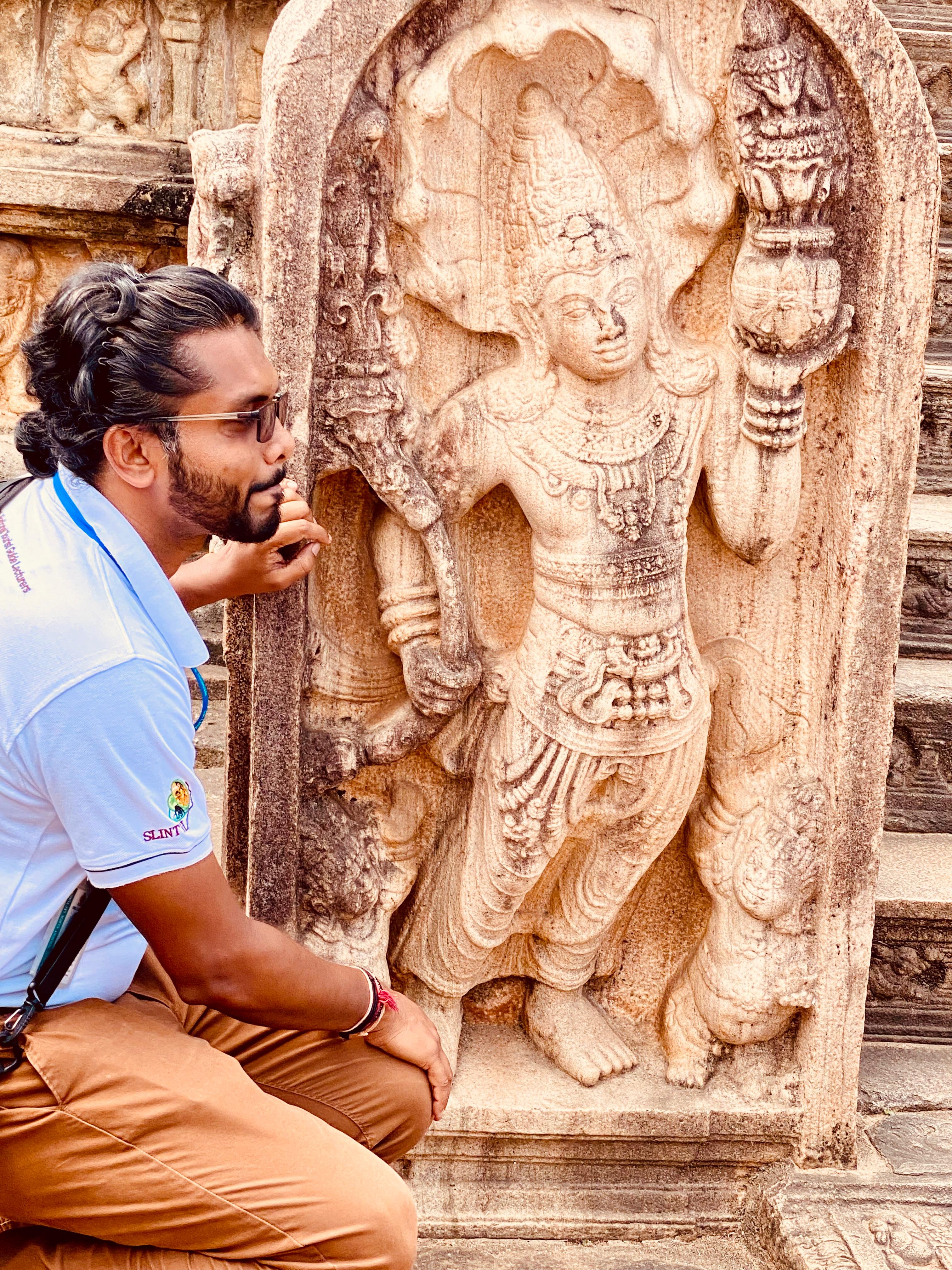
Meet one of Raahi’s travel experts from Sri Lanka, who believes tourism should be about more than numbers. In this conversation, he shares his experiences, challenges, and vision for making Sri Lankan tourism more meaningful. We chatted on phone with him for a conversation about his journey, his perspective on Sri Lankan tourism, and the changes he hopes to see in the industry.
1. If you had just 48 hours to convince someone to fall in love with Sri Lanka, where would you take them—and why?
I would take them first to Yapahuwa, the fourth kingdom in Sri Lanka and a place not much visited but having a good first impression on Sri Lanka. Then I am taking them to Anuradhapura, The first kingdom that lasted for more than 15 centuries. First to Vessagiriya and Isurumuniya, Sri Lanka’s first pleasure garden. Then to Sri Maha Bodhi and Ruwanweliseya, the utmost venerated stupa by Buddhists at night. To finish the following day, I am taking them on a safari at Wilpattu National Park, not crowded like Yala NP.
Why? In 48 hours, they would experience Sri Lanka’s lesser-known heritage, the living traditions of one of its most sacred cities with the marvels of our craftsman and the wild beauty of a national park away from the crowds.
2. What’s the biggest myth tourists believe about Sri Lanka before they arrive?
Most travelers think Sri Lanka is similar to India, or southern India, but the moment they arrive in Sri Lanka, they realize it’s different.
3. You’ve met travelers from all over the world. What’s one question they ask that always makes you smile?
When travelers exchange USD, euros, or Australian dollars, they get a huge pile of local notes/ cash! The notes can be confusing, and I’ve often had to stop my tourists from giving an LKR 5,000 note instead of an LKR 500 note.
On the other hand, travelers find the beautiful designs of Sri Lankan currency really amazing with the endemic birds, butterflies and the dancing traditions on them.
4. If Sri Lanka were a person, how would you describe its personality in just three words?
Adventurous, Resilient, Welcoming.
5. Every travel professional has a story. What’s the funniest or most unforgettable experience you’ve had while leading a tour?
One of my most unforgettable experiences happened during a National Geographic cultural expedition while climbing Sigiriya, the Lion Rock - a UNESCO declared world heritage site. One of my guests suffered a heart attack while climbing the steep rock, far from immediate medical help. I had to act quickly to help him.
During the farewell dinner, he looked at his wife and said, “This is the man who saved my life.”
It left me speechless, and it will stay with me for the rest of my life.
A guide should be more than a narrator, he should be a protector, decision-maker and often the quiet hero of the journey.
6. How did you build your travel business? How easy or hard was it in Sri Lanka?
When you do something wholeheartedly in Sri Lanka, I think the initial part is quite easy. Your guests become friends and are keen to send their friends and family to Sri Lanka. Word of mouth is the best way to get them to visit you.
Then the problems start. Getting licenses and going through time-consuming quality checks was fucking hard, you know! Even today, after I’ve applied for the Pvt Ltd company, there has been no answer for six months.
7. If you became Sri Lanka’s Minister of Tourism for one year, what are the first three changes you’d make?
- The first thing I would do is remove the three million target. That creates unnecessary pressure on the country. I would encourage people engaged in tourism to get a proper license and enter formal tourism.
- I would remove the restrictions and barriers that make it hard to start a tourism-related business in Sri Lanka. I would take all the necessary institutions under one roof and encourage them to invest here.
- I would gather all the service providers under one platform, such as Raahi.
8. In your opinion, what’s the biggest roadblock preventing Sri Lanka from becoming one of Asia’s top travel destinations?
I think it’s the policy and the mindset of the people. Policy makers should live the tourism life and walk in the shoes of the travellers. They must not stick to traditional laws and regulations. If they want to spread the word, they should walk the talk.
9. What does “responsible tourism” really mean to you, and how can visitors help protect what makes Sri Lanka so special?
To me, responsible tourism means leaving the country better than we found it, not just enjoying what our country has to offer, but understanding our responsibility towards it. It also includes inclusive tourism.
Beauty is not only the beaches, wildlife, or history. It also includes culture, traditions, and ways of life. As a tourism industry professional, I have the responsibility to protect all these while creating beautiful memories for guests.
It’s simple: respecting the environment and local culture. That’s responsible tourism. I’ve always believed that sharing cultural experiences would make this industry more vibrant.
10. Fast forward ten years. What would make you proud to say, “We got tourism right”? What does that future look like?
Ten years from now, I would be proud to say “we got tourism right” if we build a tourism industry where success is measured not by the numbers, but by the quality of the guests, how many true locals get direct benefits, and the value we create for the country.
The true ambassadors of Sri Lanka are the local people, their smiles, and their genuine welcome. Formally trained guides should be promoted, wildlife should be preserved, and even our Veddah - Aboriginal community should engage in this package.
I also hope to see a more professional, technology-driven, and united tourism industry, where education, innovation and collaboration are at the heart of our growth.
Ultimately, I want returning customers, word-of-mouth recommendations, and communities proud of what they do and what they get from tourism.
11. Now you are on Raahi. What hopes, dreams, or visions of yours do you hope a platform like Raahi can help make a reality?
What excites me about a platform like Raahi is the possibility of changing the way people experience Sri Lanka and the way we manage and develop tourism. It can connect tourists, businesses, people and ultimately the country with the world.
My vision is not to see technology take over human connections, but to make it easier to build bridges and work together as communities. Making the world smaller and easy to reach within one platform. That’s what Raahi is about.
I would love to help Raahi bring together local knowledge, professional guides, authentic experiences, communities, and technology into one strong ecosystem.
Personally, Raahi is an opportunity to bring the “world” together (apps, communities, countries……) and put all what I’ve learnt into use for the betterment of the industry. To make Sri Lankan Tourism Meaningful.